How to Check the Breaker Before Electric Water Heater Repair
A tripped breaker can explain cold water, but it cannot tell you what caused the problem. Learn the safe limits of a homeowner check, when one reset is appropriate and which warning signs mean you should stop.
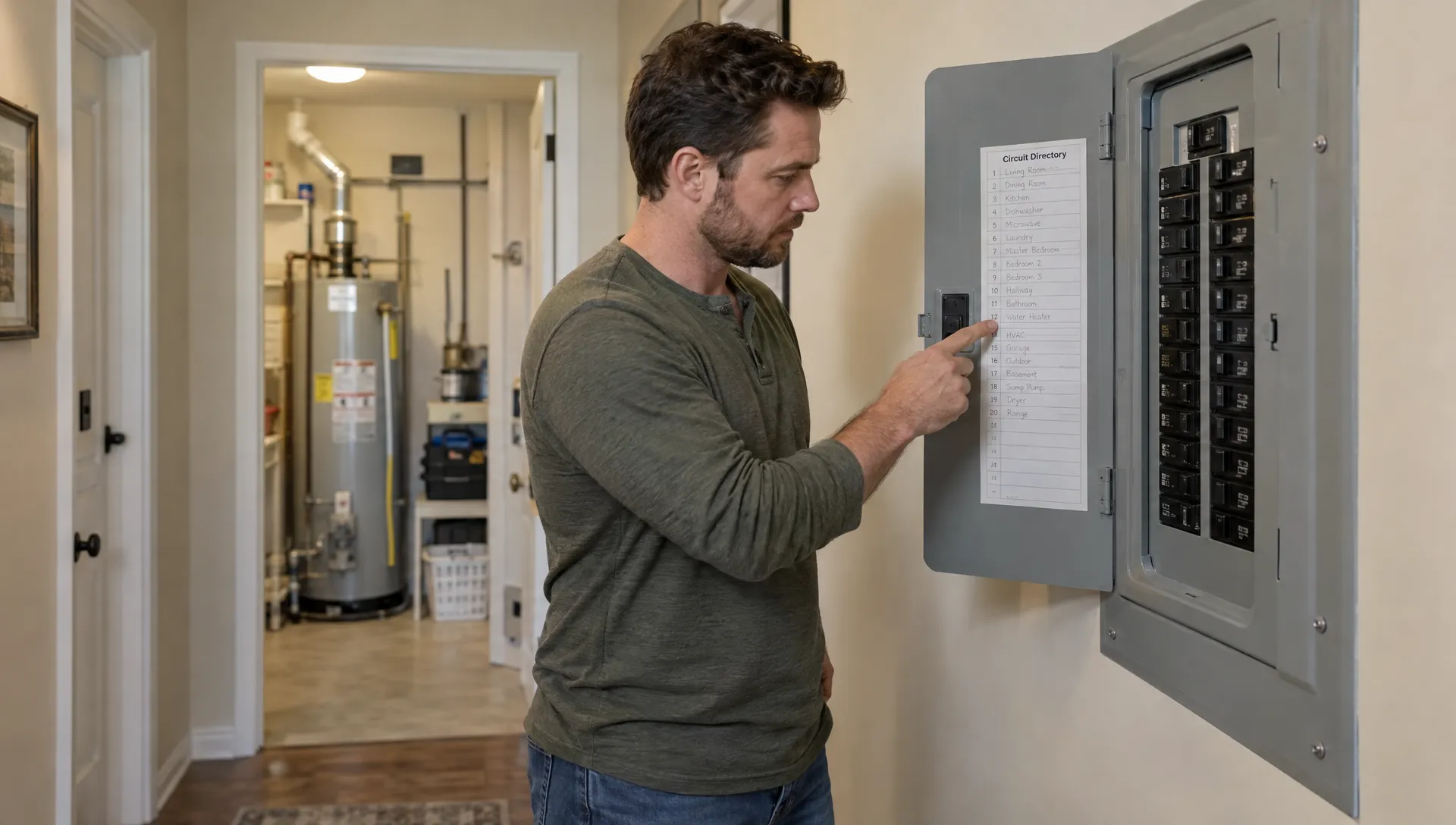
No hot water does not automatically mean your heater has failed. Before scheduling electric water heater repair, you can check the circuit breaker without opening the appliance or touching wiring. A tripped breaker may explain the loss of hot water, but it does not explain what caused the trip.
The safe homeowner check is limited: inspect the area, identify the correct breaker, observe its position and, only under suitable conditions, reset it once. Do not remove electrical covers, test live terminals or keep resetting a breaker that trips.
Stop first if you notice electrical warning signs
Do not approach or operate the panel if there is standing water, moisture on the panel, visible damage, a burning smell, crackling or unusual heat. Do not touch a wet water heater or walk through water near electrical equipment.
For smoke, sparks or an active fire, move away and call 911. Otherwise, have a licensed electrician assess an unsafe panel or circuit before anyone attempts a reset.
Also stop if the heater was recently drained, its water supply is shut off or you cannot confirm that the tank is full. Energizing an empty or partly empty conventional electric tank can damage its heating elements. Ask the installer or plumber to confirm proper filling before restoring power.
A breaker is a protective device, not simply an on/off switch. Safe electric water heater repair starts with treating a trip as a warning rather than an inconvenience.
How to check the water heater breaker safely
1. Identify the correct circuit
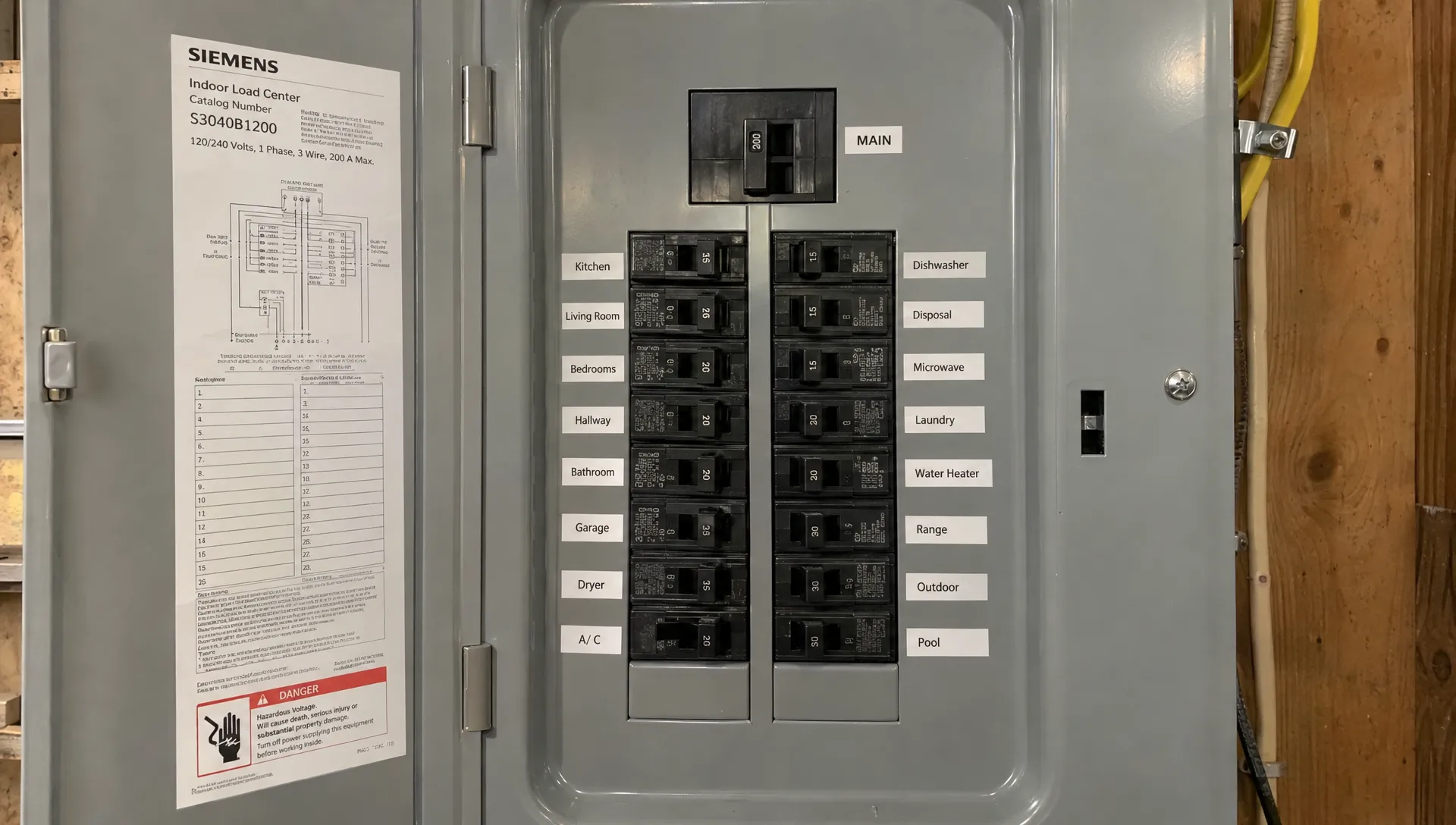
Use the panel directory to find a breaker labeled “water heater,” “WH” or a similar description. Most conventional whole-house electric storage heaters use a dedicated 240-volt circuit with a double-pole breaker. Its handles typically operate together.
Do not assume every heater has this arrangement. Electric tankless models may use multiple circuits, and heat pump water heaters can have different electrical requirements. Follow the equipment manual for your model.
If labels are missing or unclear, do not flip breakers at random or remove the panel's protective cover to trace wires. Ask an electrician to identify and label the circuit. Never replace a breaker with a higher-rated one to prevent trips.
2. Observe the handle position
With dry hands, dry footing and no warning signs, open only the panel's normal hinged outer door, if present. Leave the screwed-on protective cover, also called the dead front, in place.
Depending on its design, a tripped breaker may sit between ON and OFF or show a trip indicator. Some trips are less obvious, so consult the breaker's markings rather than guessing.
Before arranging electric water heater repair, note whether the handle appears ON, OFF or tripped. These observations help the technician, but none confirms that the heater is receiving the correct voltage.
If the breaker is OFF, do not automatically turn it on. Someone may have intentionally shut it off for maintenance, a leak or an electrical fault. Check with other household members or the person who last serviced the equipment.
3. Reset a tripped breaker only once, if conditions are safe
A single reset may be reasonable when the correct breaker is clearly identified, the panel and surrounding area are dry, the tank is known to be full and there is no known fault or history of repeated trips.
Operate only the normal breaker handle. For a typical resettable breaker, move it fully to OFF, then to ON, following the manufacturer's instructions. Do not force a stiff handle or try to hold it in place.
If it trips immediately, will not stay on or trips again later, stop resetting it. Leave it off and arrange professional diagnosis. An immediate trip can indicate a short circuit or ground fault; a delayed trip can also signal a problem requiring testing.
If you are uncomfortable operating the breaker, skip the reset and call for help.
4. Allow recovery time, then check a faucet
If the breaker stays on, a cold storage tank will not produce hot water immediately. Recovery depends on tank capacity, element wattage, incoming water temperature and how much hot water is being used. Use the manufacturer's recovery guidance rather than expecting instant results.
The U.S. Department of Energy's guide to storage water heaters explains how these systems store and heat water. A tankless unit operates differently, so waiting for a storage tank to recover is not the right test for every model.
After the appropriate wait, check hot water carefully at a faucet and avoid other hot-water use during the check. Be alert for unexpectedly hot water that could scald.
For electric water heater repair, whether the water stays cold, turns lukewarm or heats normally is useful diagnostic information. Do not increase the thermostat setting as a workaround.
What your breaker check can and cannot tell you
The breaker position narrows the next step. It does not identify a failed part or prove that an electrical circuit is safe to touch.
| What you observe | What it may mean | Safest next step |
|---|---|---|
| Breaker is clearly tripped | The circuit's protection operated | Consider one reset only if all safety conditions are met |
| Breaker trips again | An unresolved appliance or circuit fault may be present | Leave it off and request diagnosis |
| Breaker appears ON, but all faucets stay cold | Supply power, heater controls or heating components may have a fault | Arrange professional testing |
| Other faucets get hot, but one fixture does not | A faucet cartridge or local mixing issue may be involved | Have that fixture checked before assuming heater failure |
| Breaker is OFF for an unknown reason | It may have been intentionally isolated | Find out why before restoring power |
A handle in the ON position is not proof that both supply legs are present or that voltage reaches the heater. A professional must make those measurements using appropriate equipment and procedures.
Look beyond the breaker without opening the heater
A few observations can help distinguish a whole-house heating problem from a fixture or plumbing issue.
Check whether the problem affects every hot-water faucet or just one shower or sink. If other fixtures receive normal hot water, the heater is producing at least some usable hot water. A faulty mixing valve or faucet cartridge may be responsible for the isolated problem.
Consider timing, too. Running out after several consecutive showers differs from having no hot water after hours without use. Record any recent power outage, plumbing work, heater draining or change in performance.
Look for visible leakage only from a safe, dry location. Do not remove insulation, access covers or the electrical junction-box cover. The thermostat and high-limit reset button on many conventional tanks sit behind access panels, beyond the scope of this homeowner check.
When does electric water heater repair need a professional?
Call for service if the breaker trips again, hot water does not return after the expected recovery period or you notice leakage, unusual overheating or damaged equipment.
A qualified water heater technician can investigate heating elements, thermostats and the high-limit safety control. An electrician may be needed for the breaker, panel, wiring or supply circuit. Describe the symptoms when booking so the right trade can assess the problem.
A failed heating element is one possible cause of a trip, but replacing parts without testing can miss a wiring fault or another underlying issue. Replacement components must match the heater's model, voltage, wattage and manufacturer requirements. Check applicable warranty terms before authorizing work.
If you need help evaluating a contractor, Hydro Hero Plumbing's guide to choosing a water heater repair professional explains what to verify before hiring.
What to record before calling
Give the technician the heater's brand and model number if the exterior label is safely accessible. Describe the breaker position, whether you attempted one reset and whether it tripped immediately or later.
Also explain whether all fixtures are affected, how long the heater had to recover and whether there has been recent maintenance. These details are more useful than repeatedly cycling power.
Frequently asked questions
The breaker is on. Why is there still no hot water? The heater may have a failed element, thermostat or high-limit control, or there may be an electrical supply problem despite the handle appearing ON. Electric water heater repair requires testing to distinguish those possibilities. A single affected faucet can instead point to a local fixture issue.
Is the red reset button the same as the circuit breaker? No. On many conventional electric tanks, the red button resets the heater's high-limit temperature control. It is usually behind an access cover. Do not open that compartment as part of this breaker check, and do not repeatedly reset a high-limit control without identifying why it operated.
Can I check the wiring after turning the breaker off? Not as part of this homeowner procedure. Switching a breaker off does not, by itself, verify that exposed components are de-energized. Leave covers in place. A qualified professional must isolate power and verify its absence before electrical work.
Does a tripped breaker mean I need a new water heater? No. The cause could be a repairable heater component or a separate circuit problem. Replacement decisions should consider tank leakage, corrosion, repair scope, warranty coverage and whether the unit meets household demand. Review these water heater replacement considerations after the cause is diagnosed, not simply because a breaker tripped.
Get help with a water heater that will not stay on
If the breaker trips again or the water remains cold, stop the homeowner checks. For electric water heater repair in Chula Vista and San Diego County, Hydro Hero Plumbing provides water heater repair and installation, upfront pricing and free estimates.
Call (619) 289-0874 and describe what you observed. If there are warning signs at the electrical panel, contact a licensed electrician rather than attempting another reset.
Isaac Cruz
Owner & Master Plumber | C-36 Licensed | 20+ Years Experience
Isaac Cruz is the owner and founder of Hydro Hero Plumbing. A second-generation plumber with over 20 years of hands-on experience in Chula Vista and San Diego County, Isaac holds an active C-36 California plumbing contractor license and has personally overseen thousands of plumbing jobs throughout the South Bay. He started Hydro Hero Plumbing with one goal: to give Chula Vista homeowners an honest, reliable local plumber they could actually trust.
Call Isaac's Team: (619) 289-0874Need a Plumber in Chula Vista?
Licensed C-36, owner-operated, and upfront pricing on every job. Same-day service across Chula Vista and San Diego County.
Call (619) 289-0874