
What a Blocked Drain Plumber Needs to Know About Your Septic Tank
A septic backup is not always a clogged pipe, and clearing a drain may not solve the underlying problem. Learn which records, symptoms and access details help your plumber identify the right next step.
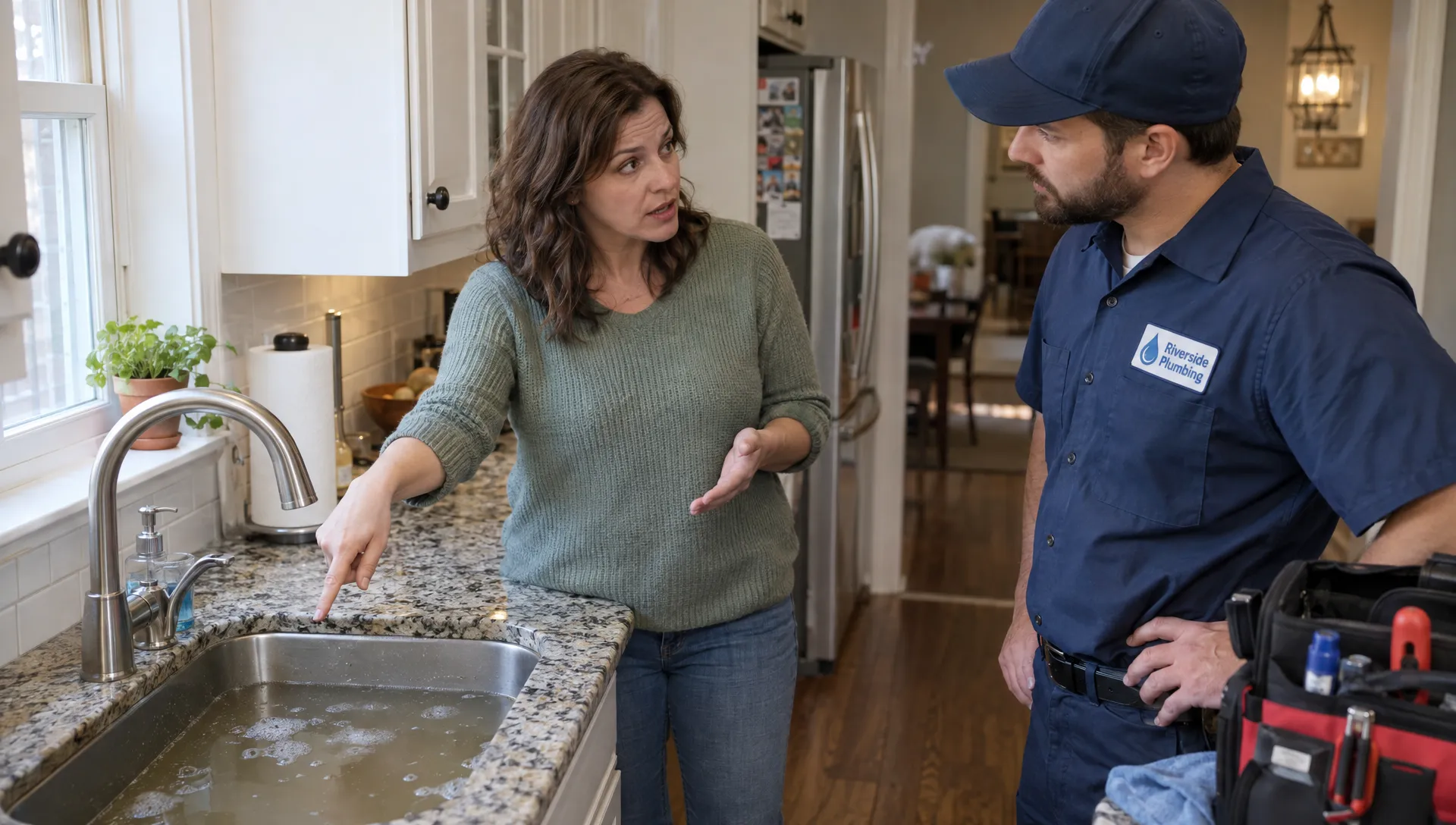
A blocked drain plumber needs more than the location of a slow sink when your home uses a septic system. The last pumping date, tank location, alarm status and pattern of backups can help distinguish a clogged pipe from a problem at the tank or drainfield. That distinction matters: clearing the house drain will not restore a saturated drainfield, and pumping a tank will not repair a broken pipe.
Before booking service, gather what you know about the system. You do not need to diagnose the failure yourself, but accurate information helps the right professional arrive prepared.
If sewage is backing up, limit damage first
Stop laundry, dishwashing, showers and other unnecessary water use if several fixtures are backing up or wastewater is entering the home. Repeated flushing to “check whether it cleared” adds water to a system that may have nowhere to send it.
Keep children and pets away from sewage and wet areas around the tank or drainfield. Do not open tank lids, lean into access openings or enter a septic tank. Toxic gases, oxygen deficiency and unstable covers can be fatal.
If wastewater is near electrical equipment, stay out of the affected area. Do not touch switches or appliances while standing in water. Seek emergency assistance for an immediate electrical hazard.
Hydro Hero Plumbing’s guide to signs that require an emergency plumber explains other situations that warrant prompt attention.
What a blocked drain plumber needs before the visit
A useful handoff includes property records, maintenance history and a clear description of what changed. Missing records are common, so share what you have without guessing about tank size or layout.
Property records and safe access
First, confirm whether the property actually uses septic. A rural setting, an old inspection cover or a neighbor’s setup is not proof. Check your purchase documents, septic permit, inspection report or utility records. If the connection remains unclear, ask the relevant wastewater utility or local onsite-wastewater authority.
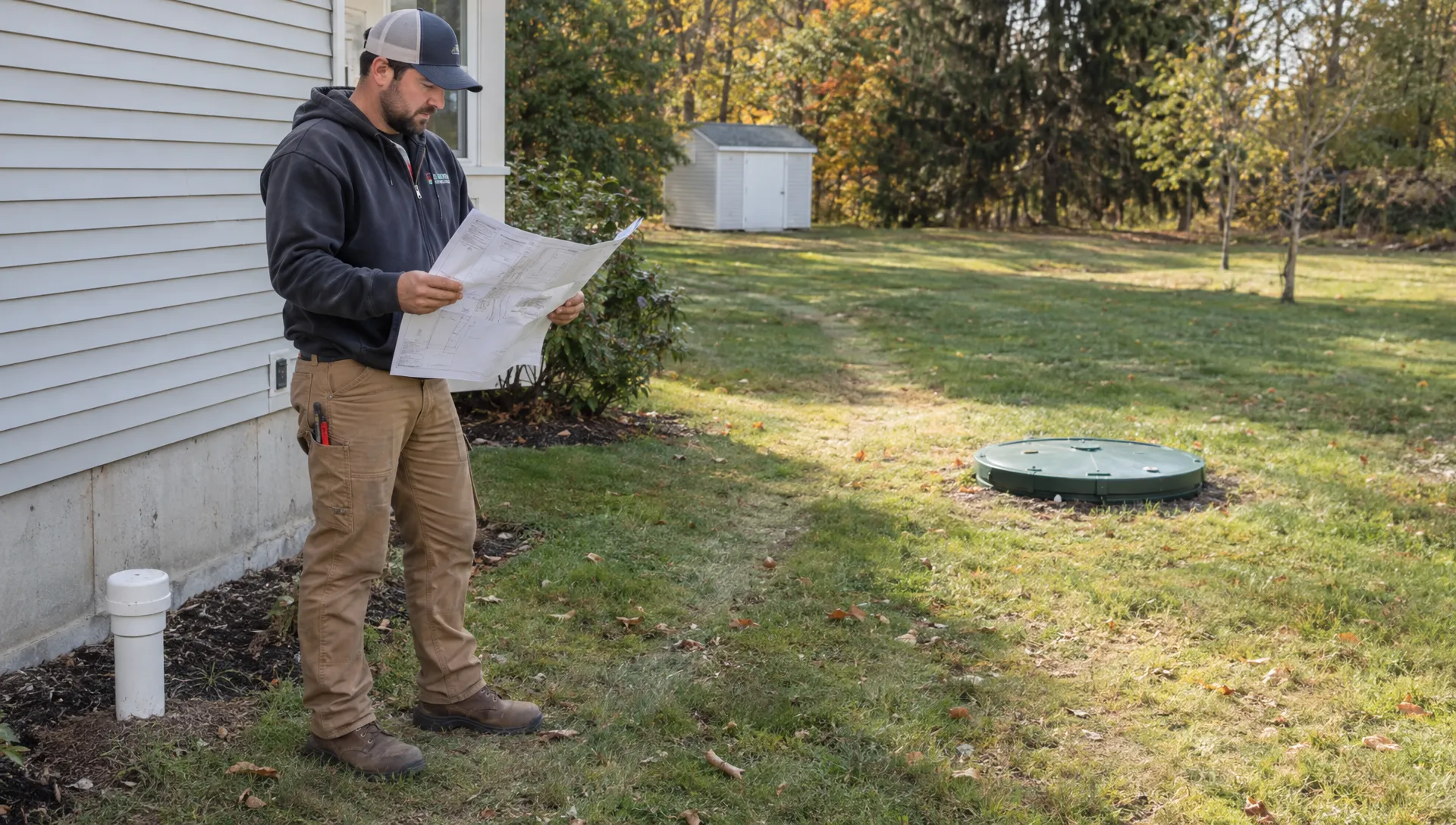
For a confirmed septic property, provide any available site plan showing the tank, building sewer, distribution components and drainfield. Mention additions, converted spaces or plumbing installed after the original system was approved.
Tell the contractor about gates, steep access, parked vehicles and known cleanout locations. A cleanout provides access to a drainpipe; it is not the same thing as a tank pumping opening.
Your blocked drain plumber also needs to know whether the suspected pipe runs beneath a driveway, retaining wall or recently landscaped area. Do not dig for access or drive over the tank or drainfield to make room for equipment.
Pumping history and system details
Find the most recent pumping receipt and inspection report, if available. These may document tank capacity, condition, access locations and recommendations that were never completed.
Report whether the system has an effluent filter, pump chamber, control panel or alarm. Conventional gravity systems and systems with pumps require different troubleshooting. An alarm signals a condition that needs investigation; it does not identify the cause by itself.
The EPA’s septic maintenance guidance explains that household septic tanks are typically pumped every three to five years, with actual needs depending on factors such as household size, tank size and wastewater volume. Alternative systems can require more frequent inspection.
A recent pumping date does not rule out trouble. A blocked inlet, clogged filter, pump failure or drainfield problem can occur even when the tank was serviced recently. Likewise, an overdue pumping schedule does not prove that accumulated solids are the only cause.
A precise timeline of symptoms
Describe the first symptom and what happened next. A kitchen sink that gradually slowed over months tells a different story from several fixtures backing up immediately after heavy rain.
Tell your blocked drain plumber whether the problem affects one fixture, one bathroom or the whole house. Mention gurgling, odors, recurring toilet backups and whether using the washing machine causes water to rise in a shower.
Recent changes are particularly useful: additional occupants, a large gathering, a leaking toilet, construction, prolonged rain or vehicles crossing the drainfield. These details can help identify increased loading or possible damage without proving either one.
Also disclose everything already attempted, including plunging, rental drain equipment, chemical cleaners and septic additives. Give the product name and approximate amount if chemicals were used. That information affects safe handling and equipment selection.
What the symptoms can and cannot tell you
Symptoms help narrow the investigation, but they rarely establish a diagnosis on their own.
| Observation | Possible explanation | Useful next check |
|---|---|---|
| One sink drains slowly while other fixtures work normally | Trap or branch-line obstruction | Inspect the affected fixture and branch |
| Several low fixtures back up together | Building sewer restriction or downstream septic problem | Locate the restriction and assess downstream conditions |
| Backups return soon after clearing | Remaining debris, pipe damage or a downstream limitation | Review the clearing result and inspect further |
| Septic alarm activates | High liquid level, pump issue, control fault or another system-specific condition | Arrange qualified septic service |
| Wet, odorous ground near the drainfield | Possible wastewater breakout or another drainage problem | Avoid contact and arrange onsite evaluation |
| Trouble follows heavy rain | Groundwater intrusion or reduced soil treatment capacity may contribute | Review weather history and system conditions |
A blocked drain plumber should explain which observations support the diagnosis and which remain uncertain. Odor alone does not prove a full tank, and a single slow sink does not automatically mean the drainfield has failed.
If records show a municipal sewer connection instead, the investigation changes. Responsibility for the private lateral and public sewer depends on local rules. Neighboring backups or utility reports may help identify a public-system issue, but the connection and obstruction location still need confirmation.
How professional clearing changes on a septic property
The goal is to identify where flow stops, then select a method suited to that location and the pipe’s condition. Sending equipment downstream without understanding the layout can miss the actual problem.
Clearing the house drain and building sewer
Mechanical cabling may remove a localized obstruction. Hydro jetting can remove certain grease deposits, sludge and other buildup, but it is not appropriate for every pipe or every septic-related blockage.
Ask your blocked drain plumber how the pipe material, existing damage and downstream septic components affect the proposed method. High-pressure cleaning should not be sent indiscriminately through tank components or drainfield piping.
A camera inspection can help identify roots, displaced joints, cracks or retained debris when access and visibility allow. Standing wastewater can obscure the view, so limited clearing may be needed before a useful inspection is possible.
A camera also has limits. It cannot establish the soil’s ability to accept wastewater, and it may not fully characterize pipe slope without additional assessment. Request an explanation of what the footage actually shows rather than treating the presence of a camera as a complete septic evaluation.
Checking the tank and downstream conditions
A septic professional may need to assess liquid levels, inlet and outlet components, accumulated solids and an accessible effluent filter. Pump systems may also require checks of floats, controls and discharge equipment.
A working septic tank normally contains liquid near its designed operating level. Seeing liquid does not, by itself, mean the tank needs pumping. Abnormally high levels can point to a downstream restriction or other problem, while pumping decisions also depend on solids accumulation and system condition.
Clearing the house line and servicing the septic system may require separate visits or different contractors. Establish who will handle each task before work begins, especially if pumping, hauling or specialized system maintenance is needed.
After any intervention, ask how flow will be verified without overloading the system. A brief improvement at one fixture is not enough to establish that a recurring whole-house problem has been resolved.
Recognizing when clearing is not the repair
If the drainfield cannot accept wastewater, repeatedly opening the house drain will not restore its function. Pumping may temporarily reduce the liquid volume, but it does not repair unsuitable soil conditions, damaged distribution piping or a failed treatment area.
A blocked drain plumber can address a pipe obstruction within the agreed scope, while a qualified septic specialist evaluates conditions beyond it. Ask for that distinction in writing when both problems may be present.
Changes to septic components, replacement work or drainfield repairs may require local approval. In San Diego County, confirm the applicable onsite-wastewater requirements before authorizing alterations. Do not assume a routine drain-cleaning scope covers septic design or permitted replacement work.
Agree on scope, qualifications and charges
Verify the contractor’s current license status through the California Contractors State License Board and request proof of insurance. Explain that the property uses septic when booking, then ask whether the company handles only the plumbing-side blockage or can coordinate additional septic service.
Confirm availability rather than assuming “emergency service” means immediate attendance at any hour. Give the dispatcher the severity of the backup, alarm information and any access hazards.
The estimate should distinguish diagnosis from clearing, inspection and repair. Ask whether camera work, locating, difficult access, after-hours attendance and a return visit are included. If septic pumping is needed, clarify whether that is a separate provider and invoice.
Before authorizing work, ask your blocked drain plumber what result the quoted service is intended to achieve. “Restore flow through the building sewer” is a different commitment from “resolve the septic system failure.” Both may be necessary, but they are not interchangeable.
For a closer look at access, equipment and repair-related charges, review what affects clogged drain repair costs beyond the service call. Avoid relying on a generic advertised clearing price for an undiagnosed septic backup.
Keep financing separate from the repair decision
Obtain the written scope before comparing payment options. If borrowing is necessary, compare the APR, fees, repayment total and eligibility rather than focusing only on how quickly funds arrive.
Online lending information is jurisdiction-specific. For example, Swift Credit’s borrowing and eligibility information concerns Singapore’s lending market, not California repair financing. Use terms applicable to your location and do not let a fast funding offer substitute for a clear diagnosis or a second estimate on major work.
Frequently asked questions
Should I call a plumber or a septic pumping company first? For an isolated fixture blockage, a plumber is usually the appropriate starting point. For a septic alarm, wastewater surfacing outside or a known tank issue, contact a qualified septic service provider promptly. When the cause is unclear, give your blocked drain plumber the full symptom history so the visit can be scoped appropriately.
Will pumping the tank unclog the house drain? Not necessarily. Pumping removes tank contents, while a blockage in the pipe from the house may still require separate clearing. Ask which finding supports each recommended service.
Can I use chemical drain cleaner or septic additives? Avoid adding chemicals to an undiagnosed backup. Drain cleaners can create handling hazards and may harm plumbing or septic processes. The EPA does not recommend septic additives as a substitute for proper operation and maintenance.
Can I keep using water if only one drain is slow? An isolated slow fixture may be a local problem, but stop using that fixture if water is backing up. If additional fixtures become affected, an alarm sounds or sewage appears, stop unnecessary household water use and arrange prompt service.
What should I keep after the repair? Save the written diagnosis, invoice, inspection findings, any camera recording provided and septic service records. Record what was cleared or repaired, where it was located and any recommended follow-up.
Arrange the right plumbing visit
When calling a blocked drain plumber, lead with three facts: the property uses septic, which fixtures are affected and whether there is an alarm or outdoor wastewater. Have your maintenance records ready and explain any chemicals already used.
Hydro Hero Plumbing provides drain cleaning, hydro jetting and sewer repair services across Chula Vista and San Diego County, with upfront pricing and free estimates. Call (619) 289-0874 to discuss the plumbing-side problem and confirm whether separate septic service is needed. Regular business hours are Monday through Friday, 8 a.m. to 5 p.m.; ask about current emergency availability when calling.
Isaac Cruz
Owner & Master Plumber | C-36 Licensed | 20+ Years Experience
Isaac Cruz is the owner and founder of Hydro Hero Plumbing. A second-generation plumber with over 20 years of hands-on experience in Chula Vista and San Diego County, Isaac holds an active C-36 California plumbing contractor license and has personally overseen thousands of plumbing jobs throughout the South Bay. He started Hydro Hero Plumbing with one goal: to give Chula Vista homeowners an honest, reliable local plumber they could actually trust.
Call Isaac's Team: (619) 289-0874Need a Plumber in Chula Vista?
Licensed C-36, owner-operated, and upfront pricing on every job. Same-day service across Chula Vista and San Diego County.
Call (619) 289-0874