What Water Heater Service Should Include for Hard Water
Hard water can leave scale that a basic flush does not remove. Learn which checks, cleaning steps and written findings to expect so you can compare service quotes and protect your water heater.

If you are searching for “water heater service near me” because your heater rumbles, takes longer to recover or delivers less hot water, hard-water buildup deserves attention. But a quick drain-and-refill is not always enough. A useful service visit should identify the problem, use the cleaning method appropriate for your equipment and confirm that the heater operates safely afterward.
For Chula Vista homeowners, the goal is a clear maintenance plan based on the actual water supply, heater condition and manufacturer’s instructions, not a generic annual flush.
Why hard water changes the maintenance plan
Hard water contains dissolved calcium and magnesium. As water heats, those minerals can form scale on heat-transfer surfaces. The U.S. Geological Survey’s explanation of water hardness describes how mineral deposits can affect water-heating equipment.
In a storage tank, loose sediment can collect at the bottom while harder deposits adhere to surfaces and electric heating elements. In a tankless heater, scale can restrict narrow waterways and interfere with heat transfer through the heat exchanger.
These are different problems, so they need different maintenance methods. Flushing removes loose material; descaling targets mineral deposits with an approved cleaning solution. Neither procedure repairs a leaking tank, failed heating element or faulty gas control.
Hardness also varies with the water source and any treatment already installed. A service recommendation should consider a hardness measurement rather than assume every San Diego County home has identical conditions.
What should “water heater service near me” include?
A hard-water service visit should start with diagnosis, not automatically with a cleaning pump. The technician should identify the model, fuel type, maintenance history and symptoms before recommending work.
| Service component | What it should establish |
|---|---|
| Equipment and symptom review | Whether the issue involves buildup, a failed component, a leak or another plumbing problem |
| Water-hardness assessment | The hardness of the water reaching the heater and whether existing treatment works |
| Appropriate cleaning | Whether the unit needs sediment flushing, manufacturer-approved descaling or additional access for cleaning |
| Condition and safety inspection | The state of accessible connections, applicable safety devices and serviceable components |
| Operational testing | Whether the heater refills, heats and delivers water correctly after service |
| Written findings | What was done, what remains unresolved and when maintenance should be reconsidered |
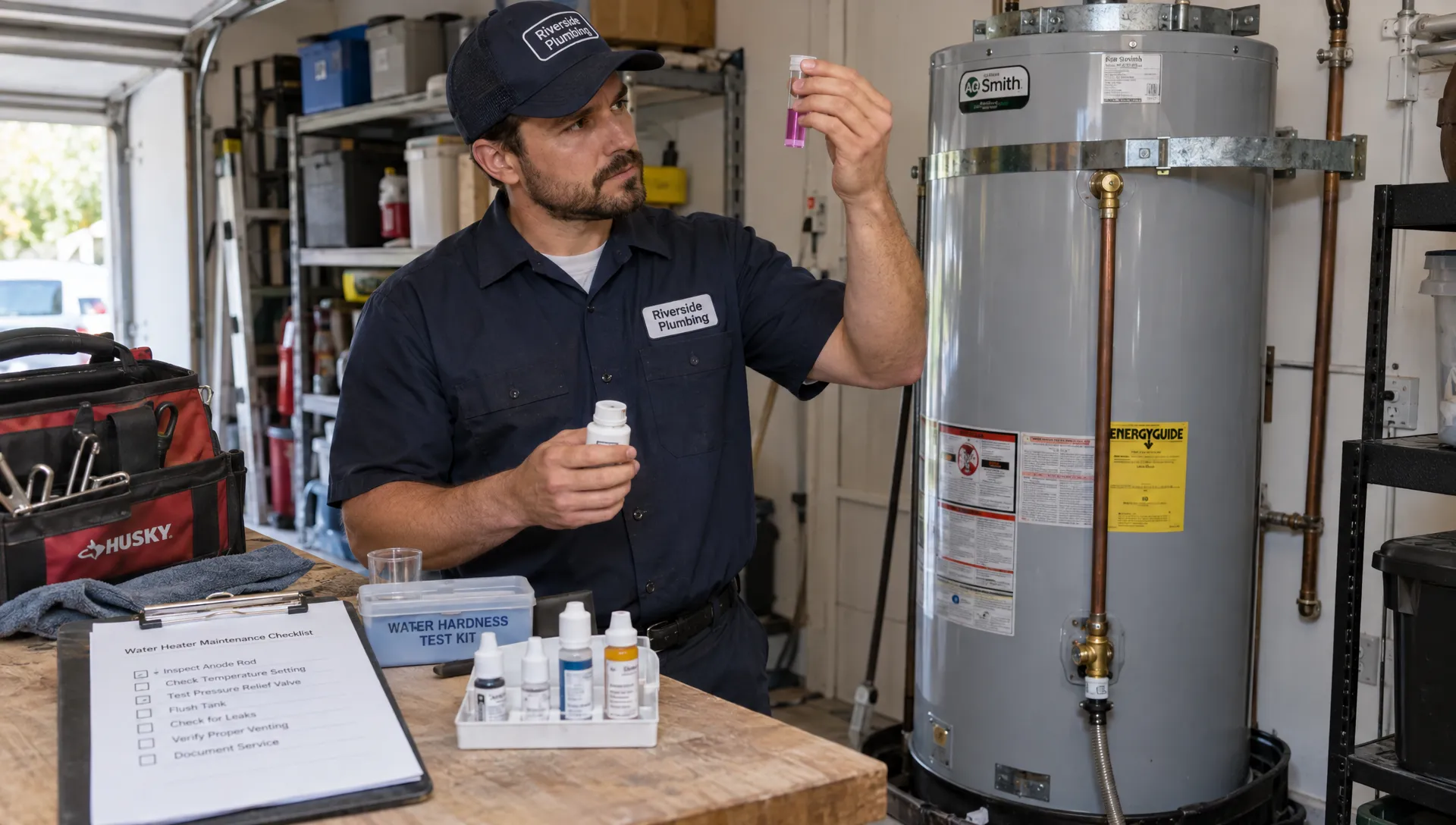
Not every visit includes every procedure in the base price. Anode inspection, element removal and chemical descaling may involve additional labor. The estimate should identify those differences before work begins.
Storage tanks: flushing, element inspection and anode condition
For a storage heater, ask whether the proposed work is a basic drain, an actual sediment flush or a more involved cleaning. Simply emptying water does not prove that significant sediment has been removed.
The technician should assess the drain valve, accessible connections and evidence of corrosion or leakage. On electric models, scale-covered elements may require separate inspection or replacement. Energy must be isolated appropriately before servicing, and an electric tank must be completely filled before power is restored.
When comparing “water heater service near me” listings, ask specifically whether anode inspection is included or priced separately. Many conventional tanks use a sacrificial anode rod to help protect against corrosion. Its replacement depends on condition, tank design and manufacturer guidance, not merely whether the water looks clear after flushing.
A severely deteriorated tank needs a condition assessment before aggressive maintenance. Cleaning cannot restore metal already lost to corrosion.
Tankless heaters: approved descaling and complete rinsing
Tankless maintenance typically requires a different scope. Where the manufacturer specifies it, a technician circulates an approved descaling solution through the heat exchanger using the appropriate service connections, then rinses the system thoroughly.
Ask which cleaner will be used and whether its concentration, circulation time and disposal method follow the model’s instructions. Household vinegar is not a universal substitute for every manufacturer-approved procedure.
The technician should also inspect applicable inlet screens, filters and service valves. Restricted flow can come from a clogged screen, scale, a fixture problem or a component fault, so cleaning alone may not resolve the complaint.
Before leaving, the technician should return valves to their operating positions, check for leaks and test hot-water delivery. If the heater lacks service valves, adding them may be a separate installation task rather than part of the quoted cleaning price.
Safety checks should match the equipment
Hard-water maintenance should not overlook unrelated hazards. Gas heaters need an appropriate inspection of accessible gas connections, combustion-air provisions and venting. Electric heaters require attention to electrical connections and signs of overheating, with power safely isolated when necessary.
The temperature-and-pressure relief valve and its discharge piping also deserve inspection. Testing or replacement should follow the manufacturer’s instructions and account for the condition of the installation. The valve must never be capped or disabled.
A useful “water heater service near me” quote should explain which safety and operating checks accompany the cleaning. For a heat-pump water heater, applicable air-filter and condensate maintenance may also belong in the visit. Those tasks are separate from removing mineral deposits inside the water circuit.
Set the next service date using evidence
Annual maintenance is a common starting point, but it is not the correct interval for every heater. The Department of Energy’s water-heater maintenance guidance points homeowners toward regular maintenance and model-specific instructions.
A sensible interval accounts for measured hardness, hot-water use, operating temperature and the amount of buildup found during the visit. A busy household with substantial scale may need attention sooner than a lightly used system receiving softened water.
Ask the technician to record the cleaning date, findings, parts replaced and recommended follow-up. For tankless equipment, note any maintenance reminders or error codes and what was done to address them.
The most useful result from a “water heater service near me” appointment is a documented baseline. At the next visit, those records help show whether the interval is appropriate or whether deposits are accumulating faster than expected. Avoid accepting a fixed schedule without any explanation of how it fits your heater.
Prevent buildup without confusing filtration and softening
Cleaning addresses existing deposits. Water treatment may reduce future buildup, but the equipment must match the water problem.
A conventional ion-exchange softener removes hardness minerals. A sediment filter captures particles, while a typical carbon filter addresses certain taste, odor or chemical concerns. Neither should be assumed to soften water. Some scale-control devices aim to reduce deposits without removing calcium and magnesium; their suitability depends on the application and heater manufacturer’s requirements.
If treatment is already installed, ask for a hardness test downstream of it. A bypassed, depleted or malfunctioning softener may leave the heater exposed to hardness despite having equipment in the garage.
Softening also does not eliminate all maintenance. Storage tanks may still need anode monitoring, and tankless heaters still have filters and other service requirements. Follow the heater manufacturer’s water-quality limits rather than relying on a promise of maintenance-free operation.
Compare the scope of work, not just the advertised price
There is no single reliable price for hard-water service without knowing the heater type, access, condition and required procedures. A tankless descale, storage-tank flush and electric-element replacement are different jobs.
Before booking, request a written explanation of the diagnostic charge, cleaning labor, chemicals and any additional parts. Ask whether the service-call fee applies toward approved work and whether taxes or disposal charges are included. A free estimate does not necessarily mean every diagnostic procedure is free.
Warranty terms matter too. Confirm whether coverage applies to replacement parts, workmanship or both, and whether a return visit carries another fee. Hydro Hero Plumbing’s guide to what plumbing repair warranties should cover explains the distinctions worth checking.
When comparing “water heater service near me” providers, also verify California contractor licensing, insurance and service coverage. This checklist for choosing a water heater repair professional can help you evaluate qualifications without confusing a low advertised starting price with a complete maintenance visit.
Keep rental-property findings separate from legal responsibility
For a rental, preserve the diagnosis, photographs and invoice before deciding who is responsible for payment. A plumber can document equipment condition, but that does not settle a lease dispute. Owners managing properties across state lines need jurisdiction-specific advice: Clair Gjertsen Weathers PLLC handles landlord-tenant matters in New York and Connecticut, while Chula Vista properties require California-specific guidance.
Know when cleaning is no longer the right investment
Maintenance makes sense when buildup is the main problem and the heater remains serviceable. Replacement deserves consideration when the tank itself leaks, corrosion is extensive, repairs recur or the equipment cannot reliably meet household demand.
Age matters, but it should not be the only deciding factor. Ask for separate repair and replacement options showing the immediate work, unresolved risks and applicable warranties. A successful flush is not proof that an aging tank has years of dependable service remaining.
Someone searching for “water heater service near me” should receive an explanation of why cleaning, repair or replacement fits the findings. Hydro Hero Plumbing’s guide to when to replace a water heater provides additional context for that decision.
Problems that should not wait for routine maintenance
A gas odor or carbon-monoxide alarm is not a descaling appointment. Leave the building, avoid operating switches or using a phone inside and contact the gas utility or emergency services from a safe location outside.
For active water leakage, avoid standing water near electrical equipment. Shut off the water supply only if you can reach the valve safely. Electrical shutoffs should be approached only from a dry, safe location; otherwise, keep clear and call for help.
Do not repeatedly reset a tripping breaker, cap a dripping relief-valve outlet or continue using equipment with suspected combustion problems. Rumbling may come from sediment, but a noise alone is not enough to rule out a more serious fault.
Frequently asked questions
Does flushing remove all hard-water scale? No. Flushing mainly carries out loose sediment. Adhered deposits may require manufacturer-approved descaling or component work, and some severely affected equipment may not be economical to restore.
How often should a tankless heater be descaled? Follow the model’s instructions, then adjust the plan using water hardness, usage and service findings. Heavy buildup at a scheduled visit is a reason to reassess the interval or water treatment.
Should I call a plumber for hard-water heater problems? Yes. A qualified plumber experienced with your heater type can distinguish buildup from leaks, flow restrictions and failed components. When booking “water heater service near me,” describe the symptoms and provide the model number if available.
Can a water softener repair damage already inside the heater? No. It can reduce incoming hardness but does not repair corrosion, replace failed parts or reliably remove existing deposits. The heater still needs its own assessment.
Request a hard-water service assessment in Chula Vista
Hydro Hero Plumbing provides water heater repair and installation across Chula Vista and San Diego County, along with water filtration services, upfront pricing and free estimates. Call (619) 289-0874 to discuss your heater, symptoms and maintenance history, and request an estimate for the appropriate work. Regular office hours are Monday through Friday, 8 a.m. to 5 p.m.; ask about current emergency-service availability for urgent problems.
Isaac Cruz
Owner & Master Plumber | C-36 Licensed | 20+ Years Experience
Isaac Cruz is the owner and founder of Hydro Hero Plumbing. A second-generation plumber with over 20 years of hands-on experience in Chula Vista and San Diego County, Isaac holds an active C-36 California plumbing contractor license and has personally overseen thousands of plumbing jobs throughout the South Bay. He started Hydro Hero Plumbing with one goal: to give Chula Vista homeowners an honest, reliable local plumber they could actually trust.
Call Isaac's Team: (619) 289-0874Need a Plumber in Chula Vista?
Licensed C-36, owner-operated, and upfront pricing on every job. Same-day service across Chula Vista and San Diego County.
Call (619) 289-0874